
Views: 0 Author: Site Editor Publish Time: 2026-03-27 Origin: Site
A weak connection point can reduce the value of an otherwise solid board design. Choosing the right PCB Metal Terminal is not only about whether it fits the layout. It also affects current transfer, soldering quality, heat handling, maintenance, and long-term reliability. For buyers working on consumer electronics, industrial control products, power modules, or other demanding assemblies, terminal selection deserves careful attention. Xinlianchuangfu manufactures terminal products for power electronics, new energy systems, industrial automation, communications, and related fields, so this article focuses on the practical factors that matter most when matching a terminal to a real application.
A PCB metal terminal does more than hold a wire. It forms the electrical connection between the PCB and the external circuit. If that connection point is poorly matched, the result may be unstable current transfer, overheating, loose joints, or difficult maintenance.
That is why terminal selection should be treated as part of the electrical design rather than a minor hardware detail. A reliable board-level connection helps improve performance, reduce rework, and support longer service life.
Reliability begins in production. A terminal may look suitable on paper but still create trouble if solderability is weak, the structure lacks stability, or the part is not well matched to the PCB and conductor arrangement. These problems can affect solder joint consistency and manufacturing efficiency.
Field conditions matter just as much. Some products work in sealed control boxes, while others face heat, humidity, vibration, or repeated switching. A terminal that works well in a simple indoor product may not be the best choice for a more demanding environment.
One common mistake is focusing too much on board dimensions and too little on the actual load. A small board does not always mean a small terminal is enough. If the application carries meaningful current or operates under thermal stress, a larger or stronger terminal may be the better option.
Current rating should be considered first because it directly influences heating and long-term stability. Voltage rating also matters because spacing and insulation performance must support the intended use. In practice, a safety margin is important, especially in power electronics, charging equipment, and industrial control systems.
Wire compatibility is another essential factor. Even if a terminal looks electrically suitable, poor matching between conductor size and terminal structure can still create unstable contact, increased resistance, or assembly problems.
The key question is not simply whether the wire can be connected, but whether the terminal can support that conductor securely and consistently over time. Good matching improves both product quality and service performance.
M3 PCB welding terminals are often a good fit for smaller boards and lower-power products where compact layout matters. In many consumer electronics applications, board space is limited, so an M3 terminal can help balance connection needs and efficient use of space.
Still, compact size should not be the only reason to choose M3. It should also match the current requirement, wire size, and operating environment.
An M4 PCB terminal provides a larger contact area and higher current-carrying capacity than a smaller option. That makes it more suitable for applications such as industrial control equipment and power management systems, where stronger electrical and mechanical performance is required.
Choosing M4 can also improve stability in products that carry more current for longer periods. In these cases, reliability is usually more important than saving a little board space.
Four-leg PCB welding terminals offer more connection support on the board and can improve mechanical retention and structural stability. This is valuable in products that face vibration, repeated load changes, or higher reliability demands.
Applications such as communication equipment and server boards often benefit from this design because the terminal must remain stable not just during assembly, but throughout transport, installation, and long-term operation.
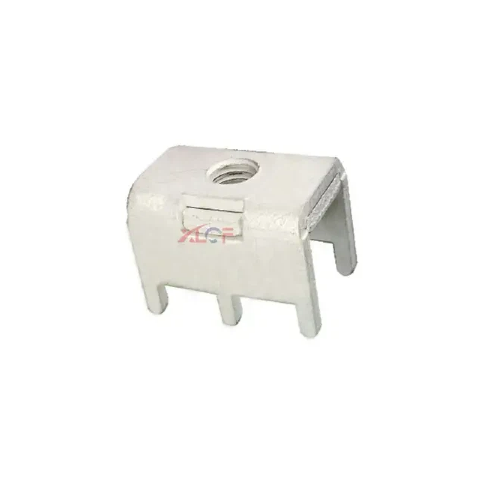
Material selection should be considered early. Brass and copper are common choices because they provide a useful balance of conductivity, strength, and manufacturability.
Copper is often preferred where strong conductivity is important. Brass can offer a practical balance between electrical performance, structural reliability, and cost. In higher-current or long-life applications, the base material directly affects heat behavior and durability.
Even a well-sized terminal can create problems if soldering performance is poor. Good solderability helps support stable wetting, reliable joints, and lower rework rates. Poor solderability can lead to weak joints and inconsistent production quality.
For buyers, this means evaluation should include not only dimensions, but also whether the terminal surface and finish support stable manufacturing and reliable assembly.
The same terminal may perform very differently in different environments. A terminal inside a sealed control box may face concentrated heat. Outdoor or industrial equipment may be exposed to humidity, temperature change, or vibration.
These conditions affect both the terminal and the solder joint over time. That is why application environment should be part of selection from the start, not checked only at the end.
Some products are expected to operate for years with limited maintenance access. In such cases, durability matters more than the lowest initial cost.
Terminal selection should reflect the expected service life of the finished product. A lower-cost part may seem attractive at first, but it can become more expensive if it leads to rework, failure, or reduced customer confidence later.
A terminal that fits the footprint is not automatically the right one. Physical fit is important, but it must also meet electrical, structural, and production requirements.
Nominal ratings do not always reflect real use. Systems that run hot, carry peak loads, or operate continuously place more stress on the connection point than basic values may suggest.
PCB terminals that look similar may differ greatly in structure, material, current capacity, and long-term reliability. Treating them as interchangeable often leads to avoidable design compromises.
Application | Current Level | Board Size | Recommended Terminal Type | Key Concern | Why It Fits |
Consumer electronics control board | Low to moderate | Small | M3 PCB welding terminal | Space efficiency | Suitable for compact boards with moderate load needs |
Industrial control module | Moderate to high | Medium | M4 PCB terminal | Current capacity | Larger contact area supports stronger performance |
Power management board | Moderate to high | Medium to large | M4 PCB terminal | Heat handling | Better for sustained load and stronger connection |
Communication equipment | Moderate | Medium | Four-leg PCB welding terminal | Stability | Extra legs improve retention under vibration |
Server motherboard support circuit | Moderate to high | Medium | Four-leg PCB welding terminal | Reliability | Better structural stability over long service cycles |
This kind of comparison helps buyers focus on application logic instead of comparing only size or appearance.
Selecting a PCB terminal is not a small purchasing detail, because the connection point affects conductivity, soldering quality, thermal stability, and long-term product reliability. The best option depends on electrical load, wire compatibility, terminal size, structural stability, material, soldering performance, and the real operating environment. Xinlianchuangfu develops terminal products for power electronics, new energy equipment, industrial automation, and communications, with solutions designed for different connection needs rather than a one-size-fits-all approach. If you are evaluating options for a new design or upgrading an existing assembly, contact us to find the most suitable PCB solder terminals for your application.
The most important factor is the real requirement of the application. Current, voltage, wire size, board space, temperature, and long-term reliability should all be considered together.
M3 is usually better for smaller boards and lower-power products. M4 is more suitable when you need a larger contact area and stronger current-carrying performance.
A four-leg structure can improve board retention and overall stability. This makes it useful in products exposed to vibration or higher reliability demands.
Material affects conductivity, strength, heat handling, and durability. It also influences soldering quality, which is important for stable production and long-term performance.


