
Views: 0 Author: Site Editor Publish Time: 2026-04-10 Origin: Site
Control cabinets become harder to manage as wiring density increases, functions multiply, and future maintenance has to be considered from the start. In that environment, a Terminal Block mounted on a DIN rail becomes more than a simple connector. It becomes part of the structure that keeps the whole system clear, serviceable, and dependable. For panel builders, equipment manufacturers, and buyers comparing connection solutions, DIN Rail Terminal Blocks offer a practical way to organize circuits, separate functions, and make later expansion easier. Xinlianchuangfu manufactures terminal products for power electronics, industrial automation, communications, rail transit, charging systems, and new energy equipment, and this guide explains what DIN Rail Terminal Blocks are, how they are used, and what buyers should look at before selecting them.
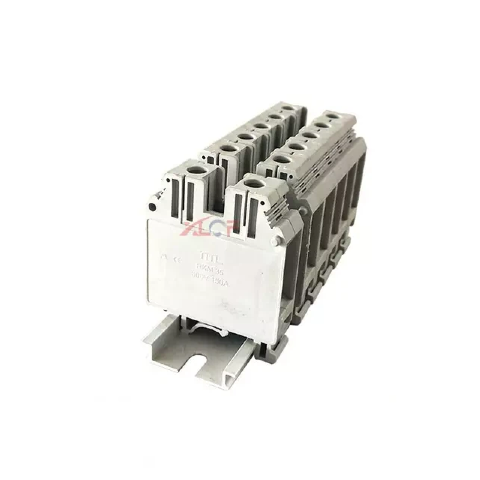
A DIN Rail Terminal Block is an insulated connection unit designed to mount onto a standardized metal DIN rail. The rail provides the mechanical base, while the terminal block provides the electrical connection point. This combination creates a modular wiring system that can be built, adjusted, and expanded with much more control than loose point-to-point wiring.
The value of this arrangement is easy to see in practical work. Instead of fixing every connection separately in a less organized way, installers can place multiple terminal blocks in a clean row on the rail and build a structured connection system. That makes the cabinet easier to assemble and much easier to understand later.
DIN Rail Terminal Blocks are common in industrial cabinets because they combine order, safety, and flexibility. In a cabinet with many conductors, neat grouping matters. Signals, control lines, power feeds, grounding points, and protective functions all need to be arranged clearly. DIN rail mounting helps create that order.
They also support modular expansion. If a system needs extra circuits later, additional terminal blocks can often be added more easily than in a less organized wiring layout. This makes DIN rail systems valuable not only for new equipment, but also for systems expected to change over time.
One of the most common uses for DIN Rail Terminal Blocks is in control cabinets and industrial automation systems. PLC panels, machine control cabinets, sensor wiring, actuator interfaces, and process control assemblies often involve many conductors that need to be routed safely and clearly. DIN rail terminal blocks help manage those circuits in a structured way.
This structure improves both installation and troubleshooting. When every connection has a defined place, technicians can inspect, label, and service the system more efficiently. That is a major reason DIN rail products are widely used in automation.
DIN Rail Terminal Blocks are also important in power distribution and interface wiring. They can be used to route incoming and outgoing conductors, organize internal cabinet distribution, and separate control signals from power circuits. In many systems, they act as the interface between field wiring and internal equipment.
This is especially valuable where a cabinet has to handle both clarity and load management. A good DIN rail layout helps reduce confusion, improves access, and supports safer maintenance procedures.
In power electronics, inverters, energy storage systems, charging equipment, and other renewable-energy-related products, orderly and serviceable wiring is essential. These systems often combine multiple functions inside one enclosure, and the wiring has to remain clear enough for safe operation and later maintenance.
DIN Rail Terminal Blocks fit this need well because they help organize conductors while supporting a modular cabinet structure. For manufacturers serving energy and electrical equipment markets, this makes them a practical long-term choice.
Feed-through terminal blocks are the most basic and widely used type. Their role is simple: they provide a direct wire-to-wire connection through a structured terminal point. They are commonly used wherever conductors need to be routed neatly from one side of a cabinet system to another.
Because of their simplicity, they are often the foundation of a DIN rail terminal layout. Many cabinets begin with feed-through blocks and then add more specialized types where needed.
Ground terminal blocks are used for protective grounding and earth connections. They help ensure that grounding conductors are grouped and connected in a controlled way, which is essential in many electrical systems.
Their value is not only electrical but also organizational. A clear grounding arrangement makes the system easier to inspect and helps reduce errors during assembly or maintenance.
Some DIN Rail Terminal Blocks are designed to do more than provide a basic connection. Fuse terminal blocks add circuit protection. Disconnect or knife-style terminal blocks make it easier to isolate a circuit during maintenance. Test terminal blocks help with measurement, commissioning, and diagnostic work.
These functional types are especially useful in cabinets where service efficiency matters. They allow the connection system to support protection and maintenance, not just wire management.
Multi-level terminal blocks help save space by allowing more than one connection level within a compact footprint. Specialty terminal blocks are designed for more specific functions, including complex interface needs or special cabinet arrangements.
These types are useful when the cabinet has limited space or when different circuit functions need to be grouped more efficiently. In dense control systems, that flexibility can be very valuable.
The first step in selection is to confirm the electrical rating and conductor range. Current, voltage, insulation requirements, and wire size all matter because the terminal block has to match the actual working conditions of the system.
A terminal block should not be chosen by appearance alone. A compact unit may look suitable, but if its rating does not fit the load or conductor size, it will not be the right solution in practice.
The second step is to look at what the terminal block needs to do. Some applications only require a feed-through connection. Others need grounding, isolation, testing, or fuse protection. Buyers should decide the required function before choosing the product style.
This helps avoid under-specifying the cabinet or adding unnecessary complication. A well-selected DIN rail terminal system matches function to circuit purpose from the start.
Cabinet space, vibration, heat, labeling needs, access for maintenance, and future expansion should also be considered. In a tightly packed cabinet, multi-level products may help save space. In a system that will be serviced frequently, disconnect or test functions may be more valuable.
Good selection always connects the terminal block to the real use environment, not just to a simple product list.
DIN Rail Terminal Blocks improve efficiency because they create a modular connection structure. Once the rail system is in place, terminal blocks can be arranged, grouped, and extended more easily than many other wiring methods. This helps speed up installation and makes later expansion more practical.
For equipment manufacturers, this also supports repeatability. A structured cabinet design is easier to reproduce across multiple units.
A cleaner panel layout is one of the most visible benefits of DIN rail systems. When conductors are grouped properly and labeled clearly, the cabinet becomes easier to understand. That helps during commissioning, fault checking, and routine maintenance.
Troubleshooting is usually faster when the wiring system is arranged logically. Technicians can identify circuits more easily and isolate issues with less confusion.
DIN rail terminal systems become even more useful when supported by the right accessories. Markers help identify circuits. End stops hold the row securely in place. Jumpers and bridges simplify common connections. Covers and other support parts can improve protection and organization.
These accessories may seem secondary at first, but they often make the difference between a basic terminal arrangement and a truly efficient cabinet system.
In practical use, DIN Rail Terminal Blocks follow a logical sequence. The blocks are mounted on the rail, wires are routed and connected, identification is added, and the finished system is inspected. This process supports both installation quality and service readiness.
The exact wiring method depends on the product type, but the broader principle remains the same: a DIN rail system works best when the connections are not only electrically correct, but also clearly arranged and easy to trace.
A good DIN rail system starts with layout planning. Terminal blocks should be grouped by circuit function, placed with maintenance access in mind, and arranged in a way that supports future expansion where possible. This planning stage helps avoid crowded layouts and makes the finished cabinet much easier to work on later.
For complex systems, layout planning is just as important as the terminal choice itself.
Type | Primary Function | Best Application | Main Advantage | Typical Cabinet Role |
Feed-through terminal block | Standard wire-to-wire connection | General cabinet wiring | Simple and versatile | Basic circuit routing |
Ground terminal block | Earth and protective grounding | Safety grounding systems | Clear grounding management | Protective connection point |
Fuse terminal block | Connection with circuit protection | Control and protected branch circuits | Combines wiring and protection | Protected interface point |
Disconnect or test terminal block | Isolation and measurement support | Maintenance-heavy systems | Easier servicing and testing | Service and diagnostic section |
Multi-level terminal block | Space-saving grouped connections | Dense cabinets and compact panels | Better use of limited space | High-density wiring layout |
This table shows that DIN Rail Terminal Blocks are not one single product category in practice. They are a family of connection solutions designed for different wiring, protection, and maintenance needs.
DIN Rail Terminal Blocks are more than simple connectors because they support a broader strategy for cabinet organization, safety, clarity, and long-term maintenance. The right DIN rail system can improve wiring efficiency, make troubleshooting easier, and give equipment manufacturers a more scalable structure for future expansion. Xinlianchuangfu develops terminal solutions for industrial automation, power electronics, energy equipment, communications, and other applications where orderly cabinet wiring matters. If you are comparing products for a new panel design or upgrading an existing wiring layout, contact us to discuss the most suitable rail-mounted connection terminals for your application.
Their main advantage is that they create a modular, organized wiring system inside cabinets and panels. This improves installation clarity, maintenance efficiency, and future expansion.
No. They are widely used in industrial automation, but they are also common in power distribution, energy storage, inverters, charging systems, and other electrical equipment that needs structured wiring.
Start with the electrical rating and conductor range, then decide the required function. Some applications need only feed-through wiring, while others require grounding, fuse protection, disconnect capability, or test access.
Accessories such as markers, end stops, bridges, and covers help improve identification, stability, and maintenance efficiency. They add real value to the cabinet system rather than serving only as optional extras.


