


| Quantity: | |
|---|---|
Center Space | 9.52mm |
Wire Range | 30 - 10AWG |
Screw Torque | 10 lbf·in |
Rated Current | 300V, 30A |
Surge Voltage | 4000V |
Insulation Body | PA66, UL94, V - 0 |
Screw Material | M3.5, STEEL |
Terminal Body | BRASS |
Temperature | -40℃ - 105℃ |
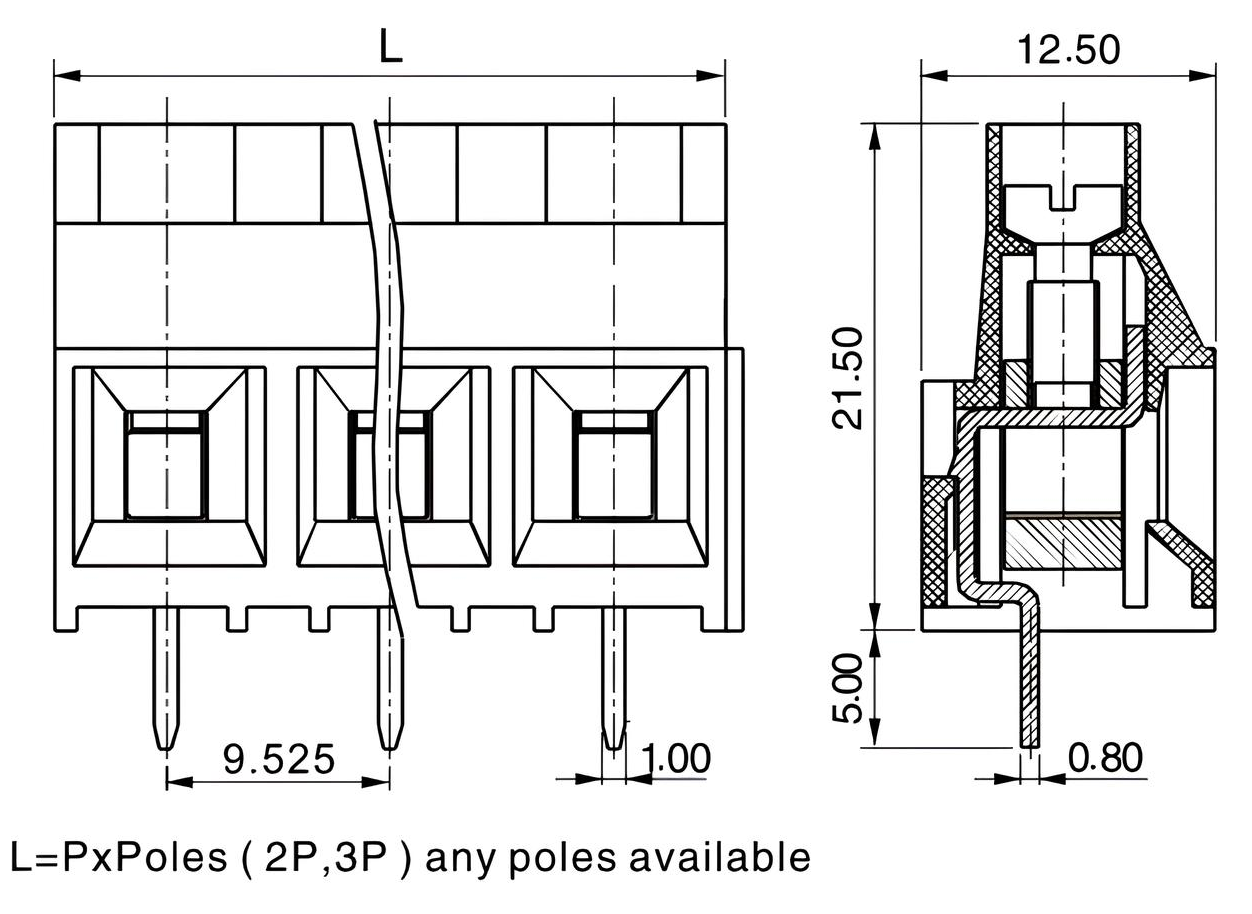
FE 5-9.52-00-XX Product Diagram
Featuring a 9.52mm wide center space (ideal for avoiding cross-talk between sensor lines) and a 300V AC/DC, 5A rating, it operates across a temperature range of -40℃ to 105℃—suitable for indoor and outdoor sensor applications (e.g., temperature probes, pressure sensors). Constructed with UL94 V-0 flame-retardant PA66 insulation and brass terminals, it meets safety standards for electronics and industrial sensors, while 3000V surge voltage resistance protects sensitive signal devices from power spikes. With a wire range of 32–20 AWG (for thin sensor wires) and modular pole design (2P to 8P), the FE 5-9.52-00-XX is ideal for IoT sensor networks, laboratory equipment, or industrial automation systems where signal integrity and spaced wiring are priorities. Its 13.2mm width balances stability with space efficiency, fitting into sensor enclosures or control panels.
9.52mm Center Space: Wider pitch reduces electromagnetic interference (EMI) between adjacent sensor wires, ensuring stable signal transmission (critical for precision sensors like pH probes or flow meters). It also simplifies wire routing and maintenance in sensor arrays.
Low-Profile PA66 Insulation: 13.2mm-wide PA66 insulation with UL94 V-0 flame retardancy resists heat and mild chemicals, while its low profile (5.8mm height) fits into compact sensor enclosures (e.g., IoT device casings).
5A/300V Rating: Designed for low-power circuits like sensor power lines (5V DC/1A), signal transmitters (12V DC/0.5A), or laboratory equipment controls (24V DC/2A). The low current rating minimizes EMI, protecting signal quality.
Brass Terminals: Corrosion-resistant brass ensures low contact resistance (<0.002Ω per terminal), maintaining signal integrity for low-voltage sensor data (e.g., millivolt-level temperature readings).
3000V Surge Protection: Withstands minor voltage spikes (e.g., from sensor power supplies), preventing damage to sensitive sensor electronics (e.g., IoT microcontrollers).
Wire Compatibility: Accepts 32–20 AWG wires, covering ultra-thin sensor wires (32 AWG for thermocouples) and slightly thicker signal wires (20 AWG for IoT data lines). The clamping mechanism features a narrow opening (2mm) to securely hold thin wires, preventing slippage.
Recommended Stripping Length: 6mm for thin wires (32–26 AWG) and 8mm for thicker wires (24–20 AWG) to ensure full contact without exposed conductors.
PCB Compatibility: The 9.52mm center space aligns with sensor PCB hole patterns (common in IoT modules), simplifying mass production. Mounts to 3.0mm holes with M2.5 screws (torque: 2.5 lbf·in max).
Supports 2P to 8P configurations, with total length calculated as L = 9.52mm × Poles. A 4P setup (38.08mm total length) fits into 40mm-wide sensor enclosures, common in industrial automation systems.
Environmental Sensors: Connects power and signal wires for temperature, humidity, and air quality sensors (e.g., smart city air monitors). The wide pitch reduces EMI, ensuring accurate data transmission to IoT hubs.
Smart Agriculture Sensors: Used in soil moisture probes, light sensors, and crop health monitors. The -40℃ to 105℃ range handles outdoor farm conditions, and brass terminals resist corrosion from soil moisture.
Analytical Instruments: Integrates into pH meters, spectrophotometers, and chromatography systems. The low current rating minimizes EMI, critical for precise measurements (e.g., millivolt-level pH readings).
Test Benches: Used in electronic component test setups for signal routing (e.g., testing sensor modules). The wide pitch simplifies wire identification and reconfiguration.
Machine Condition Sensors: Connects vibration, pressure, and temperature sensors in manufacturing machinery (e.g., CNC mills). The wide pitch reduces cross-talk between sensor signals, ensuring early detection of machine faults.
Robotics Sensors: Used in robotic arm position sensors and vision system cameras. The compact design fits into robot control enclosures, and surge protection safeguards against power spikes from robot drives.
"EMP" denotes "Extended Pitch Sensor Block," highlighting the terminal’s core advantage: 9.52mm wide center space optimized for sensor signal integrity. This differentiates it from standard narrow-pitch terminals (e.g., 5.08mm) that may cause EMI in sensor circuits.
Yes. It accepts 32 AWG thermocouple wires (common in type K/J thermocouples) and brass terminals minimize signal loss—critical for accurate temperature readings (e.g., in industrial ovens or laboratory freezers). Use a 6mm stripping length for thermocouple wires.
The 5A rating is intentional: low-power sensor circuits rarely exceed 2A, and a lower rating minimizes EMI (electromagnetic interference) from the terminal. Higher current ratings (e.g., 10A) would generate more EMI, disrupting sensitive sensor signals (e.g., millivolt-level data).
Use M2.5 stainless steel screws (length: 4–6mm) for plastic sensor enclosures or M2.5 zinc-plated steel screws for aluminum enclosures. Tighten to 2.5 lbf·in (max) to avoid cracking the low-profile PA66 insulation.


